
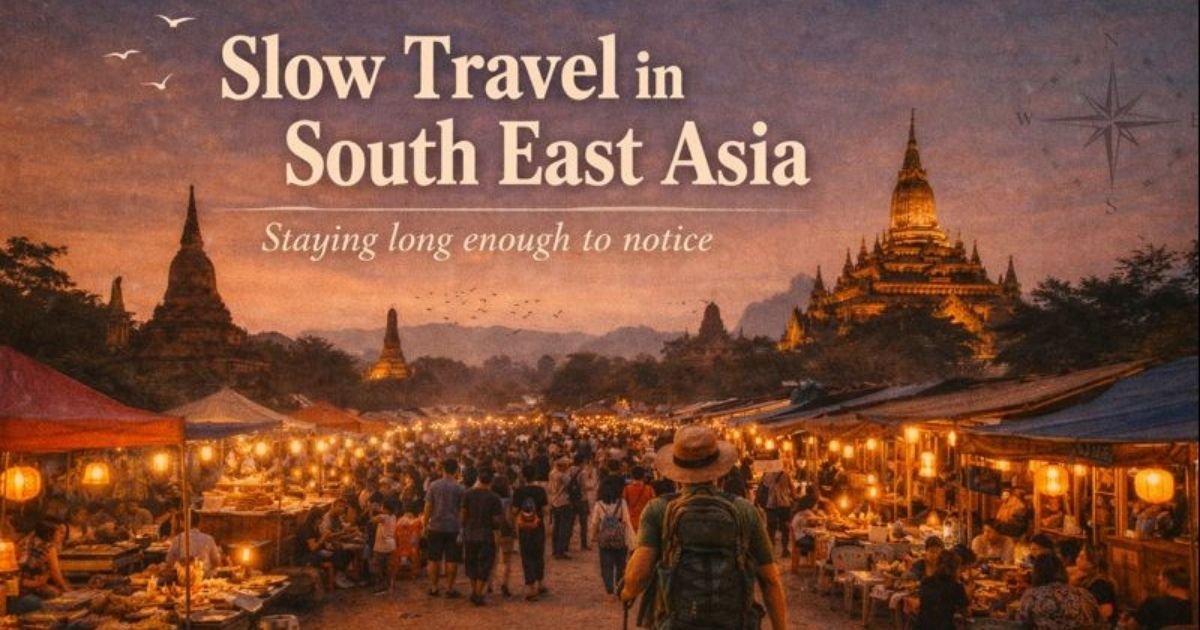
Staying long enough to notice
Southeast Asia rewards time. Not the rushed kind that hops from highlight to highlight, but the slower kind that settles into routine. The kind that notices market rhythms, seasonal work, quiet commutes, and the spaces between planned activities.
This collection of stories explores slow travel in Southeast Asia. Travel shaped by daily life rather than itineraries, by observation rather than optimisation. These are places experienced over days and weeks, not hours.
This is where travel becomes less about seeing more and more about understanding better.
What Slow Travel means here
Slow travel is often misunderstood as luxury or leisure. Here, it means something simpler.
– staying long enough for places to stop performing
– noticing how people work, eat, move, and wait
– letting geography and routine set the pace
These stories focus on everyday life, local economies, and the quiet systems that hold places together.
Featured Slow Travel stories
Northern Thailand
Markets, villages, and life near the edges of the map.
These stories focus on work, trade, and seasonal life rather than attractions. They are about watching places function rather than performing for visitors.
Southern Thailand
Low season travel and movement through everyday landscapes.
This is a story about timing, weather, and what an island feels like when it’s not trying to impress anyone.
Myanmar
The world’s biggest pile of bricks is just outside of Mandalay.
Hopefully the country will open up again soon – there is plenty to see.
Vietnam
Street culture and uncurated social spaces.
Bia Hoi is not a destination. It’s a routine. This short piece explores how informal public spaces shape social life in Hanoi.
Cambodia Village Life
Agriculture, economics, and continuity after conflict.
These stories focus on farming, trade, and livelihoods rather than history as a spectacle.
Malaysia
Islands experienced at human pace.
This story follows the rhythm of ferries, waiting, and island routines rather than resort narratives.
Indonesia
An incredibly diverse island nation
Getting from Here to There
Travel as transition, not interruption.
- Daytime Train Travel from Bangkok to Chiang Mai
- How Much Stuff do You Really Need? The Dusty Boots Packing Guide
- Renting a Scooter in SEA – Survival Guide
Why Slow Travel works in Southeast Asia
Much of Southeast Asia still runs on human-scale systems. Markets open when people arrive. Work follows seasons. Transport prioritises function over speed. Slow travel fits naturally here, not as a trend, but as alignment. These stories aim to reflect that rhythm rather than overwrite it.
If you’re planning Slow Travel in Southeast Asia
These pieces won’t tell you what to book or where to stay, but they may help you think differently about timing your travel, choosing how long to stay and noticing what happens around you.
Sometimes slowing down is less about time and more about attention.
Contribute a Slow Travel story
Have you spent time in Southeast Asia where daily life, work, or routine shaped your experience more than attractions? Lets hear your story.