
This story is part of our Remote Landscapes series.
Norfolk Island is a small island located in the Pacific Ocean between New Caledonia and New Zealand, about a 2.5 hour flight from Sydney. Although it is an external Australian territory you still need either a passport or your Australian driver’s license to enter the island. There are just over 2000 inhabitants on the island and many of them are direct descendants of Fletcher Christian, he of Mutiny on The Bounty. Such descendants will proudly tell you they are 5th or 6th generation Christian or they are married to a member of the Christian family. The Christian family runs many of the tours and businesses on the island. The other pioneer family who married into the Christians are the Baileys. The other famous resident, now deceased, was Colleen McCulloch, a prolific author and Australian Treasure.
During my visit I observed a few things about living on an island. Fresh produce is seasonal and whilst I was there I could not buy avocados, tomatoes or bananas. There is plenty of fresh fish such as Trumpeter and King fish. Fuel is delivered by ship every few weeks as are everyday items for the shops. The shops were well stocked but there is less choice compared with on the mainland. One exception is a bottle shop just out of Burnt Pine townshipwhich has a comprehensive supply of wines, beers and non-alcoholic drinks from across Australia at mainland prices. There is also a fabulous view to the coastline which you can enjoy from the deck. There are no fast food operators (fine with me), but plenty of coffee shops and eateries. People seem to go to bed early as there isn’t much in the way of late night bars or entertainment.
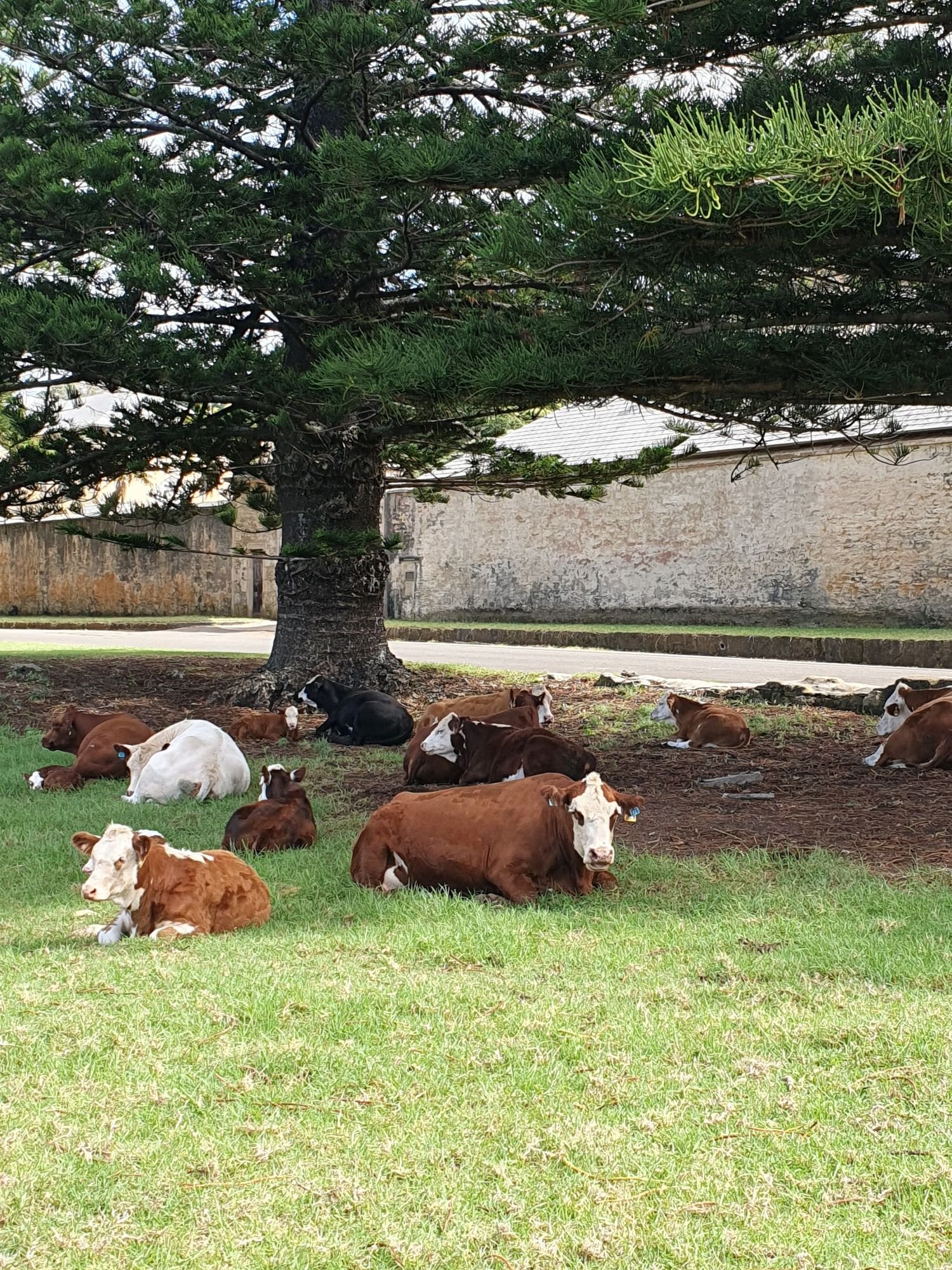
Another unique aspect of island life: the free roaming cows. They must be given way to on the roads. At night they somehow find their way back to their farms as do the chickens who also strut around the fields and roads. There are no predators such as foxes and there are no kangaroos, wombats or possums. Rabbits have been mostly eradicated. (They were introduced onto nearby Phillip Island for sport).
Being semi tropical, the temperature never goes above 26 degrees Celsius and evening temperatures stay in the mid teens year round. As a Melburnian, it was a treat to be able to sit outside each evening and enjoy the balmy temperature. It was also good not to need jackets or cardigans. Raincoats were needed one day when it rained quite heavily but it wasn’t cold. However, with the rain there was a level of humidity which I was not used to. Towels and clothing always felt damp and my hair, even after being blow dried, felt flat. The ceiling fans in the accommodation offered much needed relief at night.
There is a central school for prep to Year 12. Until quite recently, students wanting to complete years 11 and 12 had to go to the mainland and they still have to go there for tertiary education. Many young people return to work on the island and a few of our tour guides were in their 20s. Apparently, being born and bred on Norfolk Island is such a great experience it’s hard to live anywhere else!
It has a particular lifestyle that is unique and I think you would need to have either been born there or want to live in a place that is beautiful but very remote and quite isolated. I sensed a ‘small town’ mentality where everyone knows everyone’s business and a community spirit that is inward looking and resilient. Many locals speak Norfuk, a mixture of English and Tahitian, reflecting the history of the settlement of the island.
For other accounts of places where history has shaped the community, see our articles on The Bogside, Northern Ireland and the lingering of history in Vietnam.
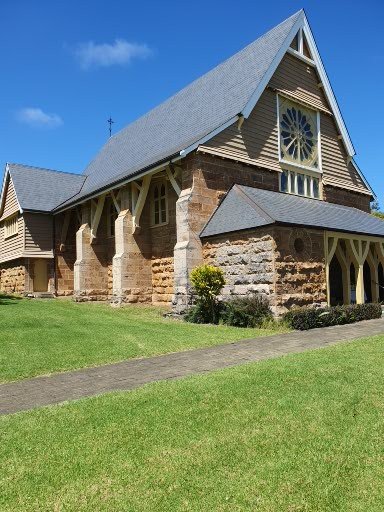
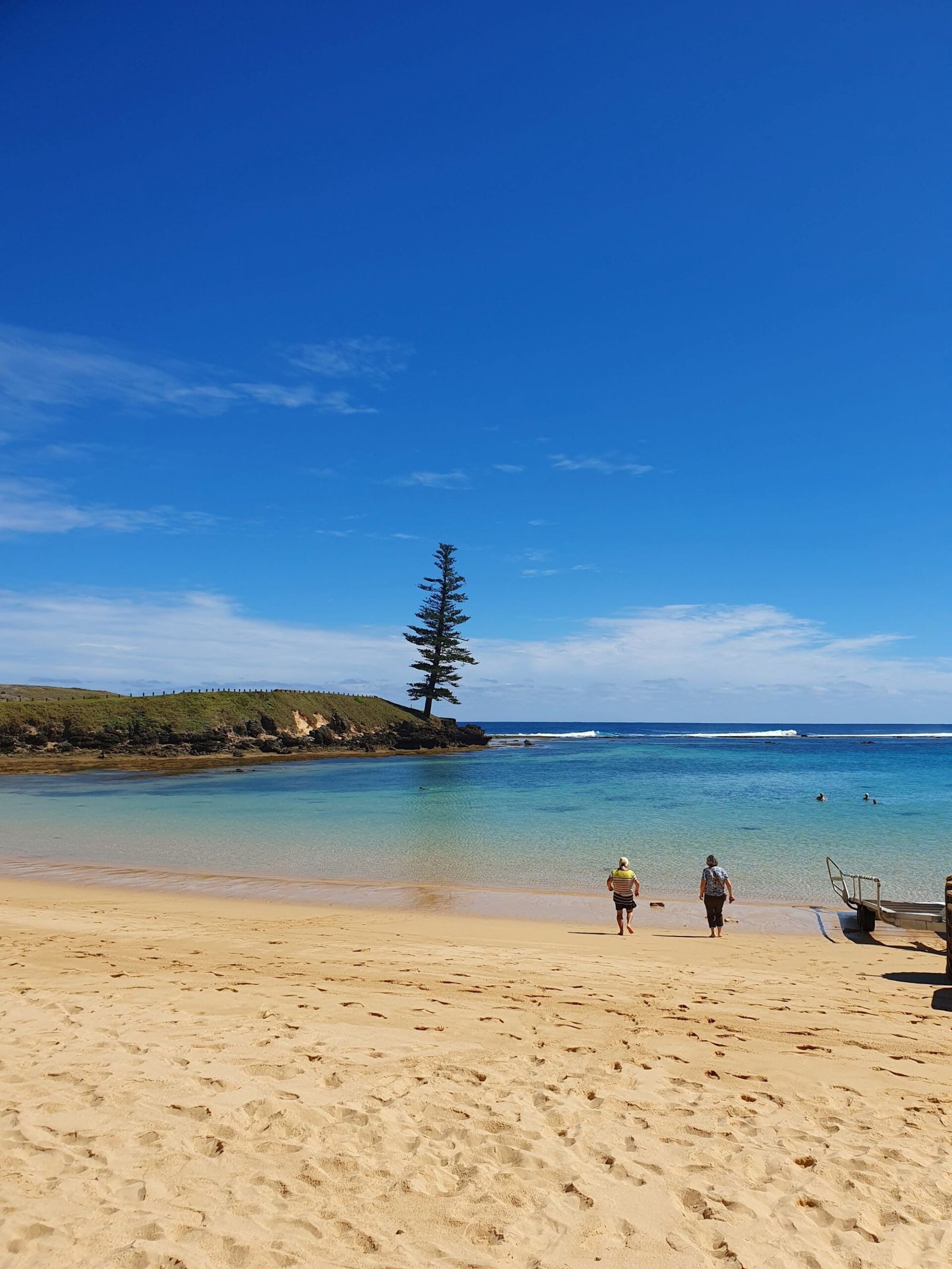
A bus tour of the whole island and its beautiful, rugged coastline is a must and it also helped me become orientated. History buffs will appreciate a tour of the penal settlement and visits to the museums on Quality Row, Kingston . I attended The Fish Fry which was very well organized and not the ‘bun fight’ I thought it would be seeing as about 100 people had to be catered for. There was great entertainment which included Tahitian style dancing, a local singer and excellent food. Similarly, the progressive dinner (which involves going to the homes of three local families) was fun and very well organised for the 50+ people attending. The Botanic Gardens were also worth visiting for the magnificent semi tropical and tropical plants. Another highlight was St Barnabas Chapel and Mission with its stunning architecture and very old fig tree. I got to look through Colleen McCulloch’s home and witness her eccentric style and hear about her life. I went on a glass bottomed boat in Emily Bay to look at fish and coral and I also got to swim in the turquoise waters there.
The best way to visit is to hire a car and drive around, stopping to explore coastal views and walks and other local attractions. Tours can be booked in the main centre of Burnt Pine. There is also plenty of accommodation, including air b&bs.
For tourist planning and information, visit the island’s official web site.
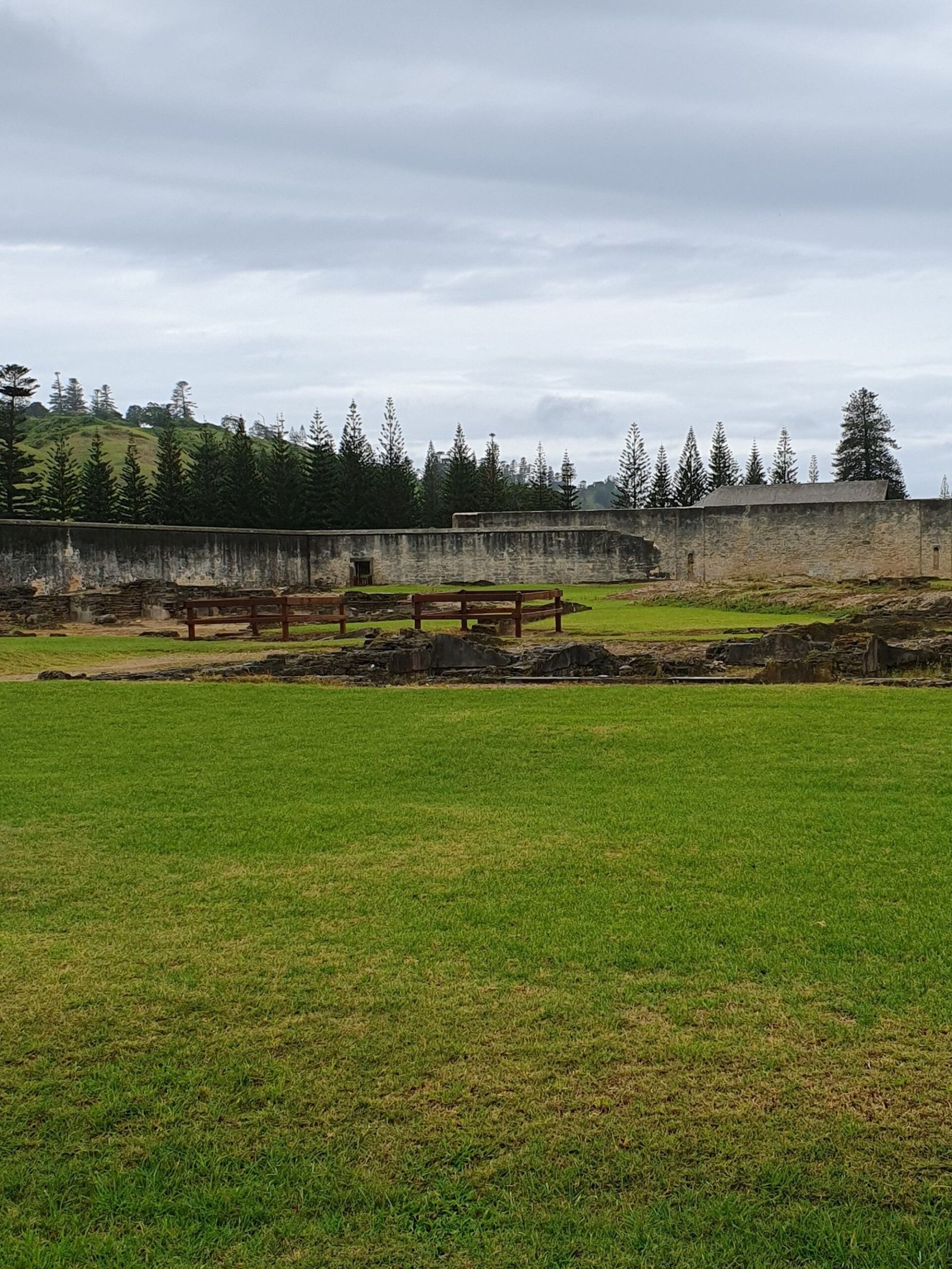
A Brutal History
Norfolk Island served as a penal colony during two distinct periods, collectively spanning from 1788 to 1855. It is remembered as one of the most brutal destinations in the British penal system.
The First Penal Settlement (1788–1814)
Established just weeks after the First Fleet arrived in Sydney, this settlement was intended to prevent other European powers from claiming the island and to utilize its timber and flax for the Royal Navy.
The purpose of settlement was to develop the island as a food bowl for Sydney and as a source of ship-building materials. While isolated and difficult to supply, it was not yet the ‘hell on earth’ it would later become.
The settlement was gradually wound down starting in the early 1800s as resources shifted to Van Diemen’s Land (Tasmania). It was completely abandoned in February 1814.
The Second Penal Settlement (1825–1855)
After being left uninhabited for 11 years, the island was reopened specifically as a place of secondary punishment for the ‘worst of the worst’ – convicts who had re-offended after arriving in Australia.
The settlement was entirely punitive. Governor Ralph Darling famously desired it to be a place of ‘the extremest punishment, short of death. It became known as the ‘Hell of the Pacific’. This period earned the island its dark reputation for extreme brutality, hard labor, and frequent uprisings, such as the Cooking Pot Uprising of 1846.
Between 1840 and 1844, Captain Alexander Maconochie introduced a ‘mark system’ aimed at rehabilitation rather than just punishment, though his methods were controversial and eventually shut down.
Transportation to the island ceased in the early 1850s. By 1855, only a handful of people remained to hand the island over to the Pitcairn Islanders who arrived the following year.
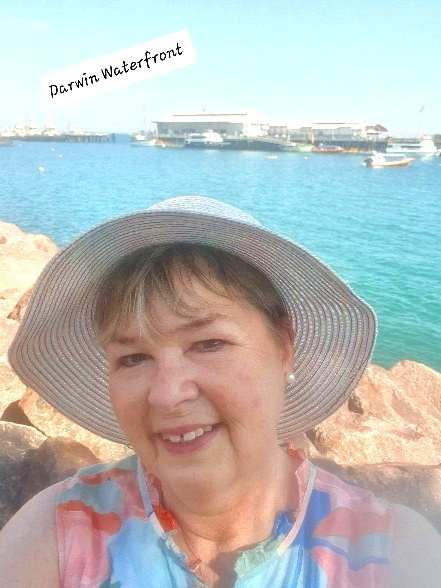
I love where I live but I also enjoy a change of scene. I love thinking of places to go and now I am retired, I am excited to explore further afield. I am a ‘gourmet traveller’ requiring some level of comfort in my accommodation and food. I also relish chance encounters with other travellers and locals. Hearing their stories and experiences adds to the flavour and perspective of the trip. I am a fan of walking in the footsteps of history and finding out about the origins of place names and buildings. Examples of local culture such as music, dance and art also always add to my travel experience.
I’m not a natural writer but it is satisfying to put my experiences down on paper as a record for others to share, along with photos of where I have been.
This was a very enjoyable article, Louise. Norfolk Island has been on my bucket list for a while.